





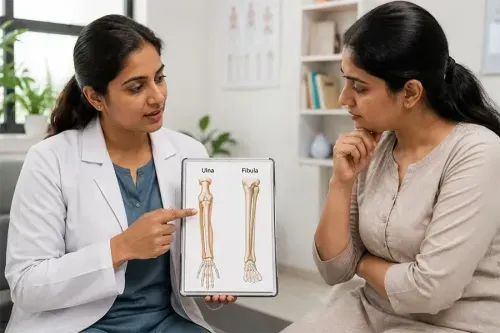
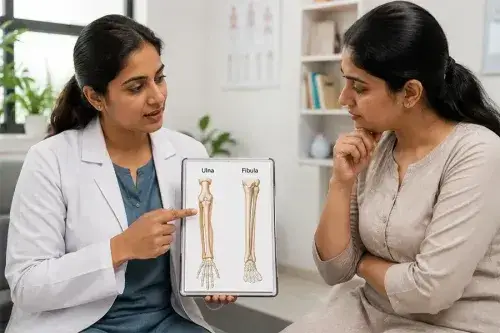
What are the Ulna and Fibula?
Ulna and Fibula Bones: Structure, Location, and Function
Bones are an essential part of our body that help in movement, staying strong, and protecting organs. Examples of two such bones are the ulna of the arm and the fibula of the leg. They might not be able to bear much body weight, but they contribute a lot in terms of support and mobility. Gaining knowledge about these bones can assist you in taking better care of your body.
What is the Ulna?
The ulna is one of two long bones of your forearm. The ulna is one of the two long bones of the forearm and works together with the radius to provide stability and movement. It is on the side of your forearm that is adjacent to your little finger. It is a long, narrow bone, and its upper end is thick and C-shaped. The proximal end of the ulna articulates with the humerus at the elbow joint, allowing hinge-like movements of the elbow.
The distal end of the ulna does not directly articulate with the wrist bones but is separated from them by an articular disc. The ulna assists in supporting movements of the arm, such as bending and straightening. It provides a powerful attachment point for muscles. These are muscles that assist in the movement of your wrist, hand and fingers.
The ulna is a large bone useful in our day-to-day activities, such as writing, lifting, pushing, or turning things. Although it does not rotate largely, it adds power and stability to your entire arm.
Where is the Ulna Located?
The ulna is on the inner side of your forearm and the opposite side of the thumb. It extends from the elbow towards the wrist and is parallel to the radius. The ulna bone remains almost fixed, whereas the radius rotates and helps in movements of the palms up and down.
What is the Fibula?
The fibula is one of the two lower leg bones. It is slimmer and smaller compared to the tibia, which is the primary bearing bone. The fibula is located on the periphery of the leg and plays a supportive and stable role. It is long, thin, and slightly curved and extends from just below the knee to the ankle. It does not join the knee directly, such as the tibia. Nevertheless, it has a major part in shaping the ankle joint at its bottom.
The fibula contributes indirectly to balance by providing muscle attachment sites and stabilizing the ankle joint. It also provides attachment sites for muscles and serves as an anatomical landmark near important nerves. Though it does not bear much body weight, it assists in ankle movement and also provides strength to the leg. In general, the fibula is an essential bone that assists in providing stability and motility of the lower extremity.
Where is the Fibula Located?
The fibula is on the periphery of the lower leg. It passes parallel to the tibia between the knee and ankle. It does not carry much body weight, but it provides strength and stability to the leg. It also facilitates muscles and protects nerves.
What are the Differences Between the Ulna and Fibula?
Both the ulna and fibula bones are long and narrow, found in various parts of our body. Each of them plays a significant role towards support, movement and connection between joints.
Let’s explore major differences between the ulna and the fibula in detail:
| Features | Ulna | Fibula |
| Location | The ulna bone is in the forearm | The fibula bone is in the lower leg |
| Shape and Size | Long and narrow | Long and slender |
| Main Function | Assists in the movement of arms | Provides muscle attachment points and forms the lateral malleolus of the ankle, which is critical for ankle joint stability. |
| Weight Capacity | Not capable of taking much weight | Does not carry too much body weight |
| Joint Connection | Helps in the formation of the elbow and wrist joints | Forms the proximal and distal tibiofibular joints with the tibia and contributes the lateral malleolus to the ankle joint |
What are the Common Problems of the Ulna and Fibula?
The ulna and fibula are two bones that are likely to be injured, mostly when a person is involved in physical activities or meets with an accident. Fractures of the ulna commonly occur due to falling or direct impacts on the arm. A frequent problem is a fracture, and it can be accompanied by a radius fracture, as both bones are located in the forearm.
Injuries to the fibula entail stress or overuse and hairline fractures. It also plays a part in ankle injuries because of its location. The management of the two bones varies with the severity of the injury. The simple ways are rest and the use of a cast or splint, and, in severe conditions, surgery might be required.
Although the ulna and the fibula are not the primary weight-bearing bones, they play a central role in body motion and stability. The ulna assists in lifting and turning your arm, and the fibula assists your leg and ankle.
The two bones are prone to injury. You can protect your bones by maintaining healthy eating habits, being active and preventing accidents. Protecting your bones now will give you a better, stronger body to live with today and to live on in later years.
Also Read:
→ Why is the Reticulospinal Tract Clinically Important
→ What is the Sebaceous Gland and its Function


Health Insurance Coverage for pre-existing medical conditions is subject to underwriting review and may involve additional requirements, loadings, or exclusions. Please disclose your medical history in the proposal form for a personalised assessment.
This FAQ page contains information for general purpose only and has no medical or legal advice. For any personalized advice, do refer company's policy documents or consult a licensed health insurance agent. T & C apply. For further detailed information or inquiries, feel free to reach out via email at marketing.d2c@starhealth.in







