





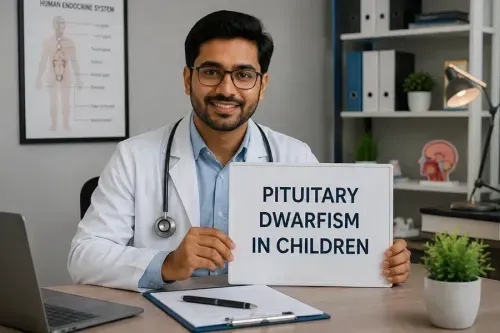
Understanding Pituitary Dwarfism in Children
Pituitary Dwarfism: Diagnosis, Risk Factors & Pediatric Endocrine Care
Pituitary dwarfism, or growth hormone deficiency (GHD), is a treatable condition; some forms are permanent, while others may be transient or resolve over time. While the underlying cause (e.g., a genetic mutation or pituitary damage) may be permanent, growth hormone replacement therapy is a highly effective treatment that allows most children to achieve a normal adult height. Treatment focuses on managing symptoms and complications along with improving lifestyles.
What Causes Growth Hormone Deficiency?
GHD can be congenital (present at birth) or acquired (develops later in life due to injury or disease). Congenital growth hormone deficiency (GHD) occurs when a child is born with a genetic mutation that affects the pituitary gland’s ability to produce enough growth hormone. This can occur due to various genetic defects, including mutations in the GH1 gene or GHRHR genes, and other abnormalities in pituitary development.
Let us discuss some potential factors that can cause growth hormone deficiency:
- Genetic Mutations: Mutations in genes responsible for producing growth hormone or its receptors, like GHRHR, can impair the release and production of growth hormone. Additionally, mutations in genes involved in pituitary development can also lead to GHD.
- Brain Structure Issues: Structural abnormalities of the pituitary or hypothalamus may be congenital, while pituitary tumors are an acquired cause of growth hormone deficiency.
- Midline Facial Abnormalities: Midline facial abnormalities, such as a cleft palate or a single upper central incisor, can be associated with growth hormone deficiency (GHD). These structural issues across the midline of the face can further support the role of developmental issues.
What are the Types of Growth Hormone Deficiencies?
Isolated Growth Hormone Deficiency (IGHD) has four clinically recognised subtypes. These differ in inheritance patterns, genetic causes, and clinical features. In this section, we will discuss these four types in detail:
1. IGHD IA (Isolated Growth Hormone Deficiency IA)
Here are some aspects of this condition:
- Inheritance: Autosomal recessive.
- Cause: Primarily mutations in the GH1 gene, leading to lesser production of growth hormone.
- Clinical Features: Severe growth failure typically becomes evident in early infancy rather than at birth.
2. IGHD IB (Isolated Growth Hormone Deficiency IB)
Aspects of IGHD IB include:
- Inheritance: Autosomal recessive.
- Cause: Mutations in either the GH1 or GHRHR gene, resulting in diminished levels of growth hormone.
- Clinical Features: Less severe growth failure compared to IGHD IA.
3. IGHD II (Isolated Growth Hormone Deficiency II)
Here are a few aspects of IGHD II:
- Inheritance: Autosomal dominant
- Causes: Mutations in the GH1 gene, leading to low but detectable levels of growth hormone.
- Clinical Features: Growth failure varies in severity.
4. IGHD III (Isolated Growth Hormone Deficiency III)
Here are some characteristics of IGHD III:
- Inheritance: X-linked recessive.
- Causes: Historically described X‑linked forms of growth failure may be associated with immunodeficiency syndromes.
- Clinical Features: Growth failure exhibiting symptoms like hypogammaglobulinemia (low levels of antibodies).
What are the risk factors for growth hormone deficiency?
Most cases of growth hormone deficiency are not preventable. There are certain risk factors which can increase your child’s likelihood of developing GHD. These include:
- Cranial radiation therapy (e.g., for brain tumors, leukemia, or prior to transplant).
- Traumatic brain injury that damages the pituitary gland or stalk.
- CNS infections (e.g., meningitis, encephalitis).
- Pituitary or hypothalamic tumors (e.g., craniopharyngioma) or surgery to remove them.
- Infiltrative diseases (e.g., histiocytosis).
How Do You Treat Growth Hormone Deficiency?
Paediatric endocrinologists primarily treat growth hormone deficiency with synthetic growth hormone replacement therapy, typically administered as injections. These injections contain recombinant human growth hormone (rhGH), which helps to replace the growth hormone not produced properly inside the body. Additionally, endocrinologists can start other hormone therapies if the patient is suffering from pituitary hormone deficiencies.
Early diagnosis and initiation of treatment are crucial for maximizing growth potential and achieving the best possible adult height outcome.
What are the Side Effects of Growth Hormone Deficiency Treatment?
Side effects of growth hormone injections to treat GHD are uncommon. However, some patients may exhibit these symptoms, depending on their immune system. These include:
- Joint and muscle pains
- Headaches
- Mild hypothyroidism
- Oedema in your hands and feet
- In children with pre‑existing scoliosis, rapid growth during therapy may lead to progression of spinal curvature
- Hip dysplasia
Sometimes, slow growth during childhood is normal and temporary, such as just before the onset of puberty. If you are concerned about your child’s delayed growth, you can consult with a paediatric endocrinologist to examine any underlying cause.
Reader Information: This article is intended for general informational and educational purposes only. Growth hormone deficiency and related growth disorders can vary significantly in cause, severity, diagnosis, and response to treatment from one child to another. All medical decisions regarding evaluation, diagnosis, and treatment should be made by a qualified healthcare professional, such as a paediatrician or paediatric endocrinologist, based on an individual child’s medical history, physical examination, and appropriate diagnostic testing.
Also Read:
→ Pisotriquetral Osteoarthritis and Its Impact on Wrist Function
→ Perforin Deficiency and Its Role in Immune System Disorders
→ What is Familial Haemophagocytic lymphohistiocytosis Syndrome


Health Insurance Coverage for pre-existing medical conditions is subject to underwriting review and may involve additional requirements, loadings, or exclusions. Please disclose your medical history in the proposal form for a personalised assessment.
This FAQ page contains information for general purpose only and has no medical or legal advice. For any personalized advice, do refer company's policy documents or consult a licensed health insurance agent. T & C apply. For further detailed information or inquiries, feel free to reach out via email at marketing.d2c@starhealth.in







