





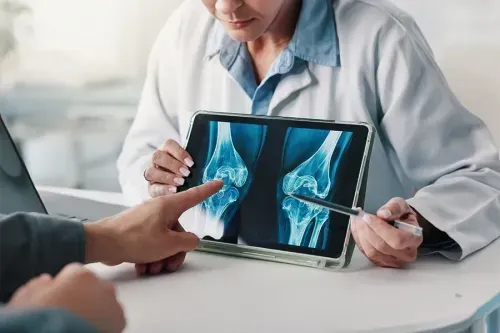
What are the Standard Surgical Procedures for a Dislocated Knee?
Knee Dislocation Surgery: Procedures, Recovery and Risks
Knee dislocations are serious orthopaedic injuries and are most commonly caused by high-energy trauma, although low-energy knee dislocations can occur, particularly in obese patients or those with ligamentous laxity. Proper and timely medical intervention is crucial to avoid long-term complications, including limb-threatening ischemia.
Read ahead to understand the treatment and surgical procedures of a dislocated knee, along with its complications, recovery phase, and more details.
How does a knee dislocation happen?
A knee dislocation happens when the bones that structure the knee joint are forced out of their original alignment, either a knee dislocation involving the femur and tibia. A true knee dislocation refers specifically to loss of alignment between the femur and tibia (tibiofemoral dislocation). Patellar dislocation is a separate and far less severe condition involving displacement of the kneecap and should not be classified as a true knee dislocation.
Causes of Knee Dislocation
Knee dislocation is a condition in which the bones of the knee joint are forced out of alignment, generally caused by high-energy trauma such as falls from heights, traffic accidents, or sports injuries, but it can also result from low-energy incidents.
High-Energy Causes
- Motor vehicle accidents: High-speed collisions or impacts can force the knee to hyperextend or rotate forcefully, resulting in dislocation.
- Falls from Crucial heights: A hard landing after a fall can result in sufficient force to dislocate the knee.
- Crush Injuries: Being struck in a situation where the knee is crushed can also result in dislocation.
Low-Energy Causes
- Sports injuries: Sudden turns, twists, or direct impacts at the time of sports such as basketball, football, or skiing can result in dislocation.
- Tripping or falling: While uncommon, low-energy knee dislocations have been documented, especially in obese individuals or those with ligamentous laxity. However, a patellar dislocation can occur from relatively minor trauma, especially in individuals with pre-existing knee instability or anatomical variations.
- Direct blows to the knee: A direct impact can forcibly trigger the kneecap to come out of its right groove.
What is the Immediate Treatment Protocol for a Dislocated Knee?
Several immediate and vital protocols can be taken during a knee dislocation, such as:
1. Emergency Management
- Reduction: Immediate closed reduction should be performed as an emergency, often in the emergency department, particularly if vascular compromise is suspected, sometimes even prior to definitive imaging.
- Immobilization: After reduction, the knee is stabilized using splints or external braces.
- Vascular Repair: Urgent vascular repair is mandatory if arterial injury or compromised blood flow is identified, as delayed treatment can result in limb loss.
2. Pain and Swelling Management
- IV Analgesics: These are intravenous (IV) painkillers and are administered to control severe pain with knee dislocation. These act fast for intense pain. Strong drugs such as opioids are used, often depending on the degree of pain.
- Ice Packs: Ice packs are used to reduce swelling and numbness in the injured knee. It is crucial to wrap ice in a towel or cloth to protect the skin. Ice should ideally be applied for 15-20 minutes at a time, with short breaks in between.
- Elevation: The injured knee is raised to heart level to reduce swelling by allowing fluids to drain away from the knee. Pillows, cushions, or any suitable object are often used to lift the leg gently. The knee should be kept elevated for the first few hours.
Patients are usually admitted for close observation, especially if neurovascular injuries are suspected.
What are the Standard Medical Procedures After the Initial Treatment?
Once the knee is stabilized, further interventions may be needed, such as:
- Ligament Reconstruction Surgery
- Typically performed after initial swelling subsides
- It can involve ACL, PCL, and collateral ligaments
- Often staged in two surgeries if the injury is severe
- Physiotherapy and Rehabilitation
- It starts with gentle range-of-motion exercises
- Progresses to weight-bearing and strengthening routines
- Full rehab may take 6–12 months
- Vascular or Nerve Repair Follow-up
- Regular Doppler ultrasound to check for arterial patency
- Neurological exams to assess nerve regeneration
What are the Complications When Knee Dislocation is Left Untreated?
Yes, untreated or poorly managed dislocations can lead to the following risks:
- Chronic instability
- Post-traumatic arthritis
- Permanent nerve damage
- Amputation (in cases with missed vascular injury)
- Deep vein thrombosis (DVT)
That's why it is classified as an orthopaedic emergency in all tertiary centres.
What is Included in the Recovery Process of a Knee Dislocation?
Recovery from a knee dislocation can be broadly divided into 4 phases, which are:
Acute Phase (0–6 Weeks)
- Rest and immobilization
- Pain management
- Passive physiotherapy
Intermediate Phase (6–12 Weeks)
- Controlled weight-bearing
- Muscle activation
- Range-of-motion exercises
Advanced Phase (3–6 Months)
- Functional training
- Balance and proprioception
- Sport-specific drills (if applicable)
Return to Activity (6–12 Months)
- Clearance based on ligament healing, MRI, and functional assessment
When Should You Seek Medical Care for a Suspected Dislocated Knee?
It’s crucial to seek immediate medical help if you experience any of the following:
- Sudden knee deformity post-injury
- Intense pain, inability to move the knee
- Numbness or discoloration in the foot
- Absence of a pulse in the foot or ankle
Don't attempt to pop the knee back into place-it can worsen nerve damage or cause blood vessel damage.
A dislocated knee is a medical emergency that requires immediate expert attention. The treatment path is complex and long-term, encompassing imaging, ligament recovery, rehabilitation, and emergency reduction.
Disclaimer: The information provided in this article is intended for general educational and informational purposes only. Always seek immediate medical attention and consult a qualified orthopaedic surgeon, emergency physician, or healthcare professional for diagnosis and treatment of a suspected knee dislocation or any related symptoms.
Also Read:
→ Which Artery is Used for Bypass Surgery
→ What is the Typical Cost of Phimosis Surgery
HELP CENTRE
Confused? We’ve got the answers
We’re Star Health. We offer the coverage that’s designed to help keep you healthy. It's the care that comes to you, and stays with you.
Knee dislocation surgery helps repair torn ligaments, reconstruct damaged tissues, and exact anatomical problems creating instability, using techniques such as the arthroscopic surgery, medial patellofemoral ligament (MPFL) reconstruction with a tendon graft, tibial tubercle transfer to align back the shin bone, or trochleoplasty to worsen the kneecap groove.
If your kneecap does not get into location by itself, then a doctor might move it back. You will be provided a local anaesthetic and might be provided a sedative so you do not feel any pain. Surgery might be required if you have badly damaged your knee. A few people might also require right surgery to halt the knee from dislocating again.
Popular Topics
People Also Search For


Health Insurance Coverage for pre-existing medical conditions is subject to underwriting review and may involve additional requirements, loadings, or exclusions. Please disclose your medical history in the proposal form for a personalised assessment.
This FAQ page contains information for general purpose only and has no medical or legal advice. For any personalized advice, do refer company's policy documents or consult a licensed health insurance agent. T & C apply. For further detailed information or inquiries, feel free to reach out via email at marketing.d2c@starhealth.in







