





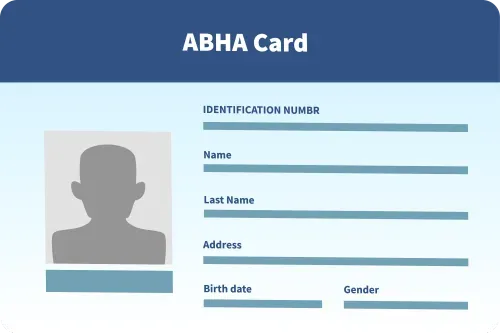
Who Is Eligible for an ABHA Card?
ABHA Card: Benefits, Eligibility, Documents and Usage
The ABHA card is a revolutionary digital health ID launched by the Government of India to help citizens get smarter access to healthcare. It simplifies healthcare by allowing individuals to securely store, access, and share their medical records.
With a 14-digit unique ABHA ID, users can efficiently manage their healthcare needs, ensuring better treatment, seamless coordination, and hassle-free access to medical services across India.
What is an ABHA Card?
The ABHA (Ayushman Bharat Health Account) card is a digital health ID launched by the Government of India in 2021. It provides each individual with a 14-digit unique ABHA ID to securely store and access his or her medical records.
The ABHA card simplifies healthcare services by enabling patients to digitally share their health information with doctors and hospitals. Thus, it improves care coordination, treatment efficiency, and ensures personalized healthcare across India.
Who Can Apply for an ABHA Card?
To apply for an ABHA card, the eligibility criteria are as follows:
Indian Citizenship
You must be an Indian national to apply for an ABHA card. Non-resident Indians cannot apply for this card.
Income Limit
This scheme aims to make healthcare accessible to economically disadvantaged families. Therefore, your annual family income should not exceed Rs. 2.5 Lakhs.
Aadhaar Card
Having an Aadhaar card is mandatory to apply for the ABHA card. This document serves as proof of identity and is required to complete the application process.
No Limitation for Categories
Everyone is eligible for this card irrespective of their caste category.
Documents Required to Apply for an ABHA Card
To apply for an ABHA Health Card, you will need to submit the following documents:
- Identity and Address Proof: Aadhaar card, PAN card, or any other valid government-issued ID can be used for verification. Make sure that your Aadhaar is linked to your mobile number, as you will receive OTP on that number during registration.
- Domicile Certificate: This is essential to confirm your place of residence in order to get access to regional healthcare benefits.
- Caste Certificate: While the ABHA card is available to all castes, submitting a caste certificate is necessary for documentation purposes.
- Bank Account Details: Provide details of the bank account linked to your Aadhaar card.
- Declaration of Medical History: You must disclose your medical history and current health conditions as part of the application.
Usage of an ABHA Card
The ABHA card offers several benefits, making healthcare access and management more convenient. Here are its main uses:
- Access to Healthcare Services: It enables users to avail a wide range of healthcare services, including AYUSH treatments.
- Sharing Medical Information: It lets you share your medical records securely with doctors and hospitals that can help in better diagnosis and treatment without the need for physical documents.
- Finding Healthcare Facilities: ABHA helps you locate hospitals, clinics, and other medical services via the Health Facility Registry.
- Digital Health Records: Safely store medical records online, allowing users to access them anytime for easy reference and better healthcare management.
- Privacy Control: Enables users to set restrictions on who can access or share their health documents.
- Doctor’s Credential Verification: Users can verify doctors' credentials through the Healthcare Professional Registry (HPR).
- Health Insurance Tracking: It facilitates tracking of insurance services and reimbursements, while also speeding up claim processing.
The ABHA card is a game-changer in digital healthcare, offering secure medical records, easy access to healthcare services, and improved treatment coordination. It ensures privacy while letting you track your insurance, get doctor verification and hospital finding. Therefore, if you are eligible, applying for an ABHA card can greatly enhance your healthcare experience.
FAQs
Any Indian citizen who meets the required eligibility Indian nationality, annual family income below ₹2.5 lakhs, Aadhaar-linked mobile number, and no caste/category restrictions is eligible for an ABHA card.
There is no minimum age requirement for an ABHA (Ayushman Bharat Health Account) card, as it is designed for every Indian citizen, including newborns and children. Parents or legal guardians can create an ABHA ID for children, which serves as a universal health identifier with no upper age limit.
The ABHA card itself does not provide free medical treatment or insurance coverage. Its primary function is to store health records digitally. However, it can be linked to the Ayushman Bharat PM-JAY scheme to access cashless, free treatment up to ₹5 lakhs per year at network hospitals.
Yes, differently-abled persons fully meet the ABHA card eligibility criteria. The ABHA card is designed to be inclusive, allowing all Indian citizens, regardless of physical ability, age, gender or socio-economic status, to create a unique 14-digit digital health ID.
No, there is no minimum or maximum age limit for getting an ABHA card. Indian citizens of all ages, including newborns, children, adults and senior citizens, are eligible to create their unique health ID to store and manage health records digitally.
Popular Topics
People Also Search For


Health Insurance Coverage for pre-existing medical conditions is subject to underwriting review and may involve additional requirements, loadings, or exclusions. Please disclose your medical history in the proposal form for a personalised assessment.
This FAQ page contains information for general purpose only and has no medical or legal advice. For any personalized advice, do refer company's policy documents or consult a licensed health insurance agent. T & C apply. For further detailed information or inquiries, feel free to reach out via email at marketing.d2c@starhealth.in







