





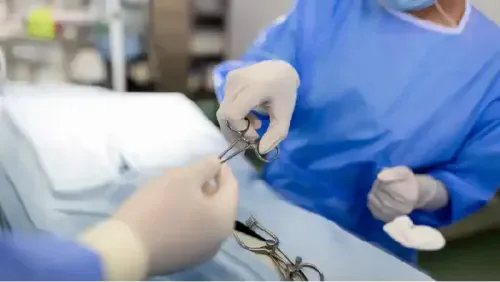
PCNL Surgery Full Form in Medical Terms
What is the Full Form of PCNL?
PCNL surgery full form is Percutaneous Nephrolithotomy. Percutaneous Nephrolithotomy refers to a surgical process that helps remove very large kidney stones that are too large to pass naturally. It involves a significant incision (though smaller than open surgery) and carries higher risks than true minimally invasive procedures (e.g., ureteroscopy).
In general, a healthcare provider recommends a percutaneous nephrolithotomy (PCNL) procedure when other methods to pass a kidney stone become unsuccessful or not possible.
History of PCNL Full Form Medically
In 1976, the Percutaneous nephrolithotomy (PCNL) procedure was first mentioned and performed by Fernström and Johansson at the famous Karolinska Institute in Sweden. Since then, this minimally invasive process, percutaneous nephrolithotomy (PCNL), has slowly become famous as one of the major treatment choices in Endourology.
What is PCNL?
PCNL surgery involves a small incision in the back to create direct access to the kidney, permitting stone removal or fragmentation.
Percutaneous nephrolithotomy is generally preferred when the large kidney stones block one branch of the collecting system of the kidney. These are called staghorn kidney stones.
For kidney stone removal, PCNL (Percutaneous Nephrolithotomy) is usually used for larger stones (over 2 cm), and RIRS (Retrograde Intrarenal Surgery) is preferred for tiny stones or for complex cases, in which PCNL may result in higher risks. This removal procedure involves small incision that is done via a 1cm incision in the skin. We have seen the PCNL surgery full form; let’s discuss the PCNL surgery procedure.
To say clearly, in the PCNL procedure, a tube is kept through the incision into the kidney using X-ray guidance. A small telescope is then passed using the tube for the purpose of seeing the stone, breaking it up and clearing it off from the body. If needed, a laser or other device known as a intracorporeal devices (e.g., laser, ultrasonic, or pneumatic lithotripters) might be used to break up the stone before it is removed.
The advantages of PCNL surgery are high stone-free rates, particularly for larger stones.
The disadvantages of PCNL surgery are it is more invasive, takes longer recovery time, and has higher complications such as bleeding and infection. PCNL is often considered suitable for large stones, but it is least suitable for patients with certain conditions or complications.
PCNL (Percutaneous Nephrolithotomy) benefits include removing kidney stones, high stone clearance rates, apt for large or complex stones, and a minimally invasive approach when compared to open surgery. Also, this results in a faster recovery and less pain. Its other benefits are early convalescence, mini PCNL, better access and the vacuum cleaner effect.
The average cost of a percutaneous nephrolithotomy procedure may depend on different variables, ranges and locations.
Complications of Percutaneous Nephrolithotomy (PCNL) Surgery
There are many complications of Percutaneous Nephrolithotomy (PCNL). Here are the general complications of Percutaneous Nephrolithotomy :
- Bleeding: A few cases of blood loss are expected, but in rare cases, the need requires a blood transfusion.
- Infection: Broad-spectrum antibiotics are generally administered to reduce the complication, but infections can still happen.
- Fever: Fever is a potential risk, particularly in patients having diabetes, staghorn calculi, or other risk factors.
- Pain: It is general to have postoperative pain and can be handled with medication.
- Urinoma: An urine collection outside the kidney, can happen.
- Ureteral Injury: Damage might happen to the ureter (the tube that connects the kidney to the bladder).
- Residual Stone Fragments: A few stone fragments might stay after the procedure.
- Fistula Formation: In the rare cases, a fistula (an abnormal connection between organs) can be developed, particularly if the tract extends into adjacent organs.
The less common but serious complications include :
- Organ Injury, that is, damage to nearby organs such as the bowel, liver, spleen, or lung, is possible.
- Pulmonary risks can include pleural effusion (fluid around the lung), pneumothorax (collapsed lung), and other respiratory problems.
- Urosepsis/Septic Shock are severe infections that spread to the bloodstream, potentially leading to life-threatening conditions.
- Acute Kidney Injury (AKI) can occur, and risk factors include higher preoperative uric acid levels, longer operative time, and intraoperative hypotension.
- Death is exceedingly rare (<0.1%) but may occur in cases of severe sepsis or uncontrolled bleeding.
Also Read:
HELP CENTRE
Confused? We’ve got the answers
We’re Star Health. We offer the coverage that’s designed to help keep you healthy. It's the care that comes to you, and stays with you.
PCNL is a method used to clear off some stones in the kidney or upper ureter (the tube which helps in the draining of the urine from the kidney to the bladder) that are very large for other forms of stone treatment, such as the shock wave lithotripsy or ureteroscopy.
PCN refers to the first stage to gain access to the renal piling up system so that devices in treating nephrolithiasis (percutaneous nephrolithotomy or PCNL) for Staghorn calculi could be inserted percutaneously.
PCNL (Percutaneous Nephrolithotomy) surgery is recommended when kidney stones are huge to pass naturally or have not responded to other treatments such as shock wave lithotripsy (SWL). This procedure is also considered for complex stones that have an irregular shape, cause blockages or recurrent infections, or when other treatments fail.
Popular Topics
People Also Search For


Health Insurance Coverage for pre-existing medical conditions is subject to underwriting review and may involve additional requirements, loadings, or exclusions. Please disclose your medical history in the proposal form for a personalised assessment.
This FAQ page contains information for general purpose only and has no medical or legal advice. For any personalized advice, do refer company's policy documents or consult a licensed health insurance agent. T & C apply. For further detailed information or inquiries, feel free to reach out via email at marketing.d2c@starhealth.in







